

Table of Contents
- Non-Surgical Nose Job in Islamabad
- What Is a Non-Surgical Nose Job?
- Why Is It Called a Liquid Nose Job?
- Non-Surgical vs. Surgical Rhinoplasty
- What Are the Benefits of Non-Surgical Rhinoplasty at Dermalase?
- Who Is an Ideal Candidate for a Non-Surgical Nose Job?
- Who Should Avoid a Non-Surgical Nose Job?
- What Fillers and Techniques Does Dermalase Use?
- What Happens During the Non Surgical Rhinoplasty Procedure?
- What Tools and Equipment Does Dermalase Use for Non surgical Nose Job?
Non-Surgical Nose Job in Islamabad
Not happy with a bump on your nose bridge, a droopy tip, or a slightly uneven profile — but not ready for surgery? A non-surgical nose job in Islamabad can fix these concerns in one short visit, with no cuts, no anesthesia, and almost no downtime.
At Dermalase Clinic in Islamabad, this treatment is performed under the direct supervision of Dr. Shumaila Khan, aesthetic physician and owner of Dermalase, together with the clinic’s in-house team of dermatologists. Whether you know it as a liquid nose job or you’ve come across the term non-surgical rhinoplasty, you’re describing the same procedure — and every treatment plan at Dermalase is built around your facial proportions, not a one-size-fits-all filler formula.
What Is a Non-Surgical Nose Job?
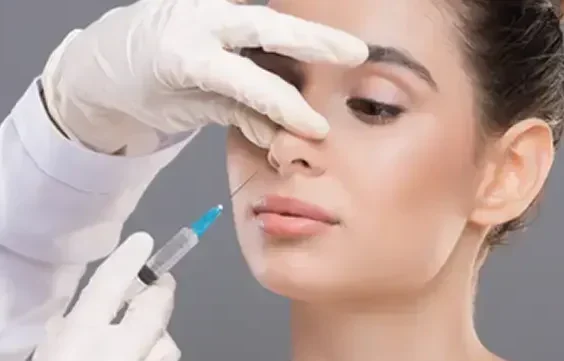
A non-surgical nose job is a cosmetic procedure that reshapes the nose using injectable dermal fillers instead of surgery. A trained practitioner injects a hyaluronic acid (HA)-based filler into precise points along the nasal bridge, nasal tip, or around a dorsal hump, to smooth irregularities, lift a drooping tip, or improve overall symmetry. Because it works by adding controlled volume — not cutting bone or cartilage — there’s no incision, no general anesthesia, and no weeks of recovery.
One thing every patient should understand clearly: filler-based nose reshaping can straighten, lift, and balance a nose — but it cannot make the nose smaller.

Why Is It Called a Liquid Nose Job?
The name comes from the technique itself: instead of surgical instruments, the practitioner works entirely with an injectable filler in liquid gel form. That’s also why patients search for the same procedure under a few different labels — non-surgical rhinoplasty, nose fillers, or non-invasive nose reshaping — depending on which term they’ve heard first. At Dermalase, all of these point to the exact same treatment, performed the same careful way, regardless of what you call it when you walk in.

Non-Surgical vs. Surgical Rhinoplasty
This is the comparison between non surgical Rhinoplast and Surgical Rhinoplasty, most patients search for but rarely find explained clearly. Here it is, side by side
| Factor | Non-Surgical Nose Job | Surgical Rhinoplasty |
|---|---|---|
| Method | Dermal filler injections | Cutting/reshaping bone and cartilage |
| Anesthesia | Topical numbing cream | General or local anesthesia |
| Procedure time | 15–30 minutes | 1–3 hours |
| Downtime | 0–2 days | 2–4 weeks |
| Results | Temporary (6–18 months) | Permanent |
| Can reduce nose size | No | Yes |
| Can correct breathing issues | No | Yes |
| Reversible | Yes — filler can be dissolved | No |
| Pain level | Mild | Moderate to significant |
| Cost | Lower | Higher |
| Best for | Bumps, asymmetry, minor tip correction | Structural change, size reduction, breathing issues |
If your concern is a small hump, an uneven bridge, or a tip that doesn’t sit quite right — and surgery isn’t something you want yet — a Liquid Rhinoplasty at Dermalase is the practical, lower-risk starting point.
What Are the Benefits of Non-Surgical Rhinoplasty at Dermalase?
- No scalpel, no incisions — performed with a fine needle or cannula only
- Immediate visible results — the new shape is visible as soon as filler is placed
- Minimal downtime — most patients return to work or routine the same day
- Low pain — only a topical numbing cream is used, no general anesthesia
- Fully reversible — hyaluronic acid filler can be dissolved if needed
- Lower cost entry point compared to surgical rhinoplasty
- Corrects the most common concerns: dorsal hump, nasal asymmetry, droopy or bulbous tip, uneven bridge, post-injury minor irregularities
- Supervised by a physician-led team, not a single technician working alone
Who Is an Ideal Candidate for a Non-Surgical Nose Job?
You are likely a good candidate for this treatment at Dermalase if you:
- Are 18 years of age or older
- Have a visible bump or dip along the nasal bridge
- Have a slightly drooping, asymmetrical, or under-projected nasal tip
- Want to “preview” a refined nose shape before considering permanent surgery
- Are in good general health, with no active infection near the nose
- Have realistic expectations of subtle, temporary refinement — not permanent restructuring
- Have no known sensitivity or allergy to hyaluronic acid fillers
Dermalase always begins with a full consultation with Dr. Shumaila Khan to confirm candidacy before any filler is injected — no treatment is done on a walk-in basis without assessment.
Who Should Avoid a Non-Surgical Nose Job?
This treatment is not right for everyone. You may not be a suitable candidate if you:
- Are pregnant or breastfeeding
- Want your nose made smaller (fillers add volume, they cannot reduce size)
- Have a history of keloid scarring or poor wound healing
- Have breathing difficulties caused by structural nasal problems (e.g., deviated septum)
- Have had recent nasal trauma or a broken nose that hasn’t been medically assessed
- Have an active skin infection or breakout near the treatment area
What Fillers and Techniques Does Dermalase Use?
Every nose reshaping treatment at Dermalase is built on medically approved materials and precise technique — not guesswork:
- Hyaluronic acid (HA) dermal fillers — the gold standard for nose reshaping, offering natural-looking results and the important advantage of being reversible if the outcome needs adjustment
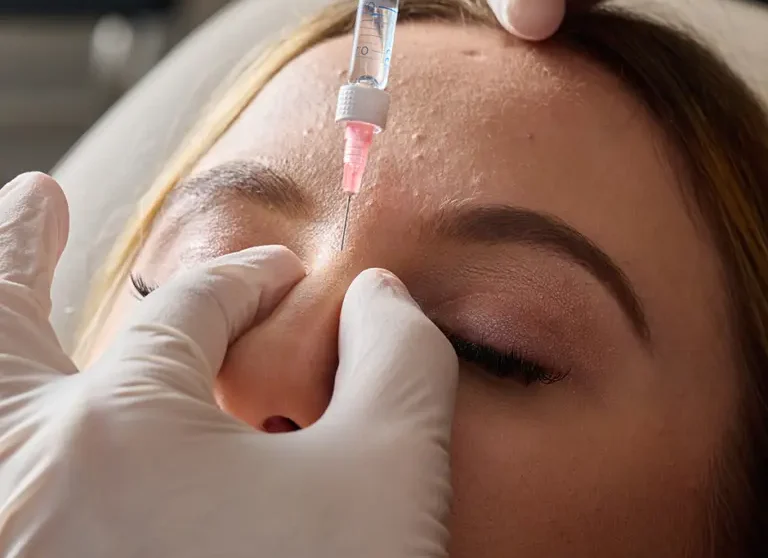
- Cannula-assisted injection technique — a blunt-tipped cannula is used instead of a sharp needle wherever possible, reducing bruising and lowering the risk of hitting a blood vessel — a key safety consideration in a vascular area like the nose
- Point-by-point facial mapping — before any injection, the practitioner maps the bridge, tip, and columella (the strip of skin separating the nostrils) to plan symmetry from multiple angles, not just straight-on
- Physician-led supervision — because Dr. Shumaila Khan owns and personally oversees Dermalase, every treatment plan is reviewed by a qualified aesthetic physician, not delegated to unsupervised staff
What Happens During the Non Surgical Rhinoplasty Procedure?
Step 1 — Consultation and facial assessment:
Dr. Shumaila Khan examines your nasal structure, skin condition, and facial proportions, and discusses your goals, medical history, and expectations.
Step 2 — Photography and injection planning:
Before-photos are taken from multiple angles, and precise injection points are marked along the bridge, tip, and sides of the nose.
Step 3 — Cleansing and numbing:
The nose is thoroughly cleansed, and a topical numbing cream is applied for about 15–20 minutes to minimize discomfort.
Step 4 — Filler injection:
Using a fine needle or cannula, the hyaluronic acid filler is injected into the mapped points in small, controlled amounts.
Step 5 — Shaping and massage:
The treated area is gently massaged to distribute the filler evenly and avoid lumps or irregularities.
Step 6 — Final review:
You’re shown the result in a mirror immediately, and any final micro-adjustments are made before you leave.
The full session typically takes 15 to 30 minutes.
What Tools and Equipment Does Dermalase Use for Non surgical Nose Job?
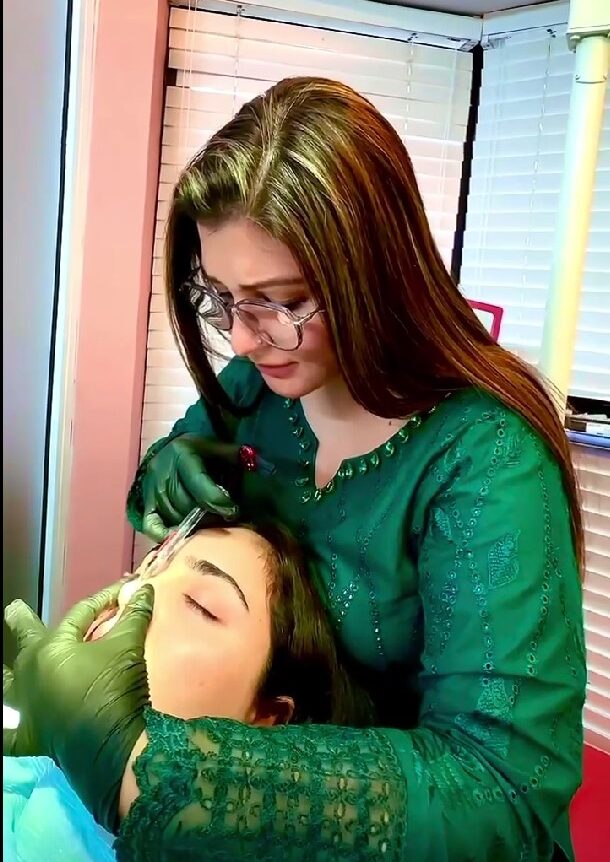
The quality of a non-surgical nose job depends as much on the tools and technique as it does on the filler itself. At Dermalase, the procedure is supported by:
- Fine-gauge needles and blunt-tip cannulas — cannulas are used wherever possible instead of sharp needles, since they glide around blood vessels rather than through them, which lowers the risk of bruising or vascular injury in a sensitive area like the nose
- Topical numbing agents — applied before injection to keep the procedure comfortable without needing general anesthesia
- Digital facial mapping and photography — used before and after treatment to plan injection points accurately and compare results across sessions
- Cooling devices — applied immediately after injection to reduce swelling and lower the chance of bruising
- Skin assessment tools used by the in-house dermatology team — since Dermalase pairs this treatment with dermatologist oversight, the skin around the nose is checked before filler is placed, not just the shape being planned
This combination — the right filler, the right injection tool, and physician-level precision — is what separates a natural-looking non-surgical nose job from one that looks visibly “filled.”
- Book This Treatment
Enquire About Dermal Fillers & Botox
Tell us a little about your concern — our team will call you back to confirm your appointment.